Incomplete communication often creates problems. You often don’t have to ask why 5 times to figure out the weakness in communication that lead to trouble. Over and over again most organization would find the problem was created, or grew, because someone that could have helped didn’t know what others knew. Making communication explicit and obvious, so that everyone that needed to know, did, will reduce problems and reduce the damage the problems that were not eliminated caused.
Making communication explicit creates a process that is less likely to result in problems that stem from communication failures.
5s for tools. Every tool has an explicit place. At a glance it is obvious if any tool is missing and where to put back any tool to be replaced. Photo from wikipedia.
For example, when a provider believes an action has been completed they should notify the interested parties. If those parties don’t believe it is complete they can speak up immediately. Otherwise people are left in the dark as to the actual state of outstanding issues and often one party is waiting for the other to get it fixed while that party considers it finished. This seems obvious, but I am personally having a problem with a property manager that doesn’t notify interested parties when they think a problem has been addressed, only updating the status when an invoice is processed which can be weeks later.
When I was responsible for program management of a software development team we would not close a ticket until the product owner considered it completed. In practice, I used my judgement to close obvious items myself but if there was any question I required confirmation (and when I did so the product owner was explicitly notified I had closed the ticket, they could let me know if they still had an issue). It is easy, when busy, to become so concerned about closing one issue to get to the next that we convince ourselves that it is close enough to what is needed. Making sure that the communication is explicit makes sure everyone agrees. Otherwise we often find those facing pressure hoping no one notices if they just don’t make explicit what they are doing.
Mistake proofing is often a matter of making an error obvious. I really prefer thinking of mistake proofing as preventing an error (such as not being able to insert usb stick the wrong way up – because it is physically design to only fit in the right side up). But at times errors are not really prevented but instead make very obvious so that they are not likely to be overlooked. Most people consider mistake-making-fairly-obvious as good enough to be considered “mistake proofing.” So for example, a zip lock back that when zipped up has a green color created where the seal is complete and doesn’t become green where the seal is not complete. This is the same concept as making communication explicit.
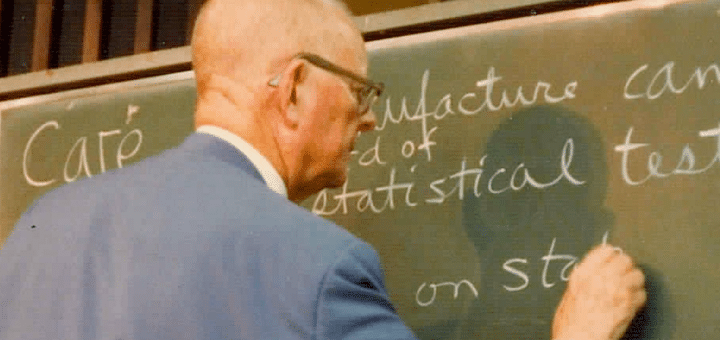
The photo gallery on the new website for The W. Edwards Deming Institute includes quite a few photos looking back at Dr. Deming’s life. Seeing the photos from when he was younger is interesting since so many of the images (and videos) we are used to seeing show him after he was 80 years old.
In Fourth Generation Management (I highly recommend this book, by the way), Brian Joiner provided an excellent summary of the options to get better “results” (as measured by the data used).
The options are to:
distort the system
distort the data
improve the system
Obviously we hope to improve the system; and we would like to have confirmation we have done so shown with data. Using data isn’t as simple as just including data in reports and in meetings. That data must be understood and we must have an appreciation for the dangers of misinterpreting data.
If a measured value improves over time it needs to provide an accurate measure of what we meant to measure, for that to be an accurate indication of success.
For example, if the time to fix identified bugs declined that seems to be a good thing. But if we have achieved that improvement by distorting the data or distorting the system it is not good evidence for an improved system.
We could, for example, distort the system by stopping new development. We could reassign all software developers to fixing bugs and in thoroughly testing existing software. We could put in quick fixes that fixed the issue raised, but only do that. So instead of doing sensible things like asking why, to find solutions that may not only fix this bug but fix other potential bugs that haven’t been reported yet (or even fix processes that would reduce bugs from being introduced in the future) we just quickly fix the issue as narrowly as we can in order to keep the measured value (time to fix bugs) as low as possible.
The quotes of Dan Pink from the webcast are backed by decades of research and support W. Edwards Deming’s views on managing people.
“We are not as endlessly manipulatable and predictable as you would think.”
“Once a task called for even rudimentary cognitive skill a larger reward led to poorer performance.”
“The best use of money as a motivator is to pay people enough to take the issue of money off the table.”
“3 factors lead to better performance: autonomy, mastery and purpose”
“When the profit motive becomes unmoored from the purpose motive, bad things happen.”
“If we start treating people like people… get past this ideology of idea of carrots and sticks and look at the science we can actually build organization and work lives that make us better off, but I also think they have the promise to make our world just a little bit better.”
Understanding psychology is an important competent of Dr. Deming’s management system. Some of these ideas come naturally to many people. Those people understand that organizations often stifle the natural gifts people want to apply at work. They can set to work dismantling the systemic de-motivation engrained in many management systems when given the opportunity.
But often we don’t question how things have been done. We are often so blind to poor practices we don’t even question them. Those practices are just accepted, without even reflecting on the merits of the practices. Recently Dan Pink has been pushing us to question our practices on motivation as many have done before, including Alfie Kohn – who was widely referenced by those applying Deming’s ideas over the past few decades. Alfie’s book, Punished by Rewards: The Trouble with Gold Stars, Incentive Plans, A’s, Praise, and Other Bribes, is particularly good.
Our new website is now live. The site has a completely new design and lots of new content, photos and videos. We hope you like the new site. Please share your thoughts on the new site by adding a comment here.
Some of my favorite content on the new site include the articles, photos, videos, timeline and short descriptions of some of Dr. Deming’s most famous ideas.
The Theories & Teachings section provides details on the: System of Profound Knowledge® (SoPK), 14 points for the transformation of management, seven deadly diseases, PDSA cycle, red bead experiment and the funnel experiment. Each includes a video of Dr. Deming talking about the ideas.
The enterprise must expect of the worker not the passive acceptance of a physical chore, but the active assumption of responsibility for the enterprise’s results.
This attitude not only is necessary for organizations to prosper today, it provides people what they need – the opportunity to be proud of what they do. That opportunity drives them to improve and provides fulfills the psychological needs people have to provide value to others.
From page 268-269:
There is a second demand the enterprise must make on the worker, that he is willing to accept change.
…
no being on heaven or earth is greedier for new things [than humans are]. But there are conditions for man’s physiological readiness to change. The change must appear rational… must appear an improvement. And it must not be so rapid or so great as to obliterate psychological landmarks which make a man feel at home: his understanding of his work, his relations to fellow workers, his concepts of skill, prestige and social standing…
As Peter Scholtes said, “people do not resist change, they resist being changed” (page 7 of the Team Handbook).
Organizations often create a climate where people are fear change. But this is more due to poor management practices than human nature. True, the result is a combination of both; when an organization doesn’t respect people, doesn’t make evidence based decisions, uses fear as a bludgeon to get people to go along… then it is human nature to resist change. Human nature will lead fearful people to seek protection from the unknown.
As part of this, an evidence based system (PDSA, for example) of improvement that results in a high rate of success with change is very helpful. If people have seen a track record of success they will accept and embrace change. If they have seen a track record of failure they will resist change.
The Essential Deming, includes material from Dr. Deming’s letters, speeches and articles. Several are from his lectures at Fordham University, including: Tyranny of the Prevailing Style of Management (page 184-5):
We’re living in prison. Under the tyranny of the prevailing style of management. A style of interaction between people, between teams, between divisions, between competitors. We need to throw overboard our theories and practices of the present, and build afresh.
…
The transformation will take us into a new system of reward. They must restore the individual, and do so in the complexities of interaction with the rest of the world. The transformation will release the power of human resource contained within, intrinsic motivation in place of competition for high rating, high grades.
There needs to be cooperation on problems of common interest between people, between divisions, companies, governments, countries. The result will in time be greater innovation, greater applied science, better technology, expansion of market, greater service, greater material reward for everyone. There will be joy in work because people will understand what their jobs are. Who depends on me? Whom do I depend on? There will be joy in learning. Anyone who enjoys their work is a pleasure to work with.
Dr. Deming talked a great deal about the importance of management focusing on the people powering organizations. That focus on psychology and motivation is often overlooked. Often, extrinsic motivation is used to substitute for intrinsic motivation; when the existing management system cripples intrinsic motivation. This is a big problem and is a big cause of the tyranny we face. Extrinsic motivation is not an effective way to cover management system faults that cripple intrinsic motivation.
Instead management needs to design and nurture a management system that allows our natural desire to take pride and joy in our work. When managing human system an appreciation for psychology allows managers to build systems that nurture intrinsic motivation and then benefit from the great results people taking pride in their work can provide.
One of the most talked about presentations at this years annual conference for The W. Edwards Deming Institute was JW Wilson’s: The Neuroscience of Deming. The talk included a great deal of detail on neuroscience which was quite interesting. While some content may have been a bit of a challenge to understand quickly, if you are not familiar with neuroscience, there was lots of great insight into how our brains work.
Fast thinking and slow thinking has been a popular topic since the publication of Thinking, Fast and Slow by Daniel Kahneman (a Nobel Laurette – in economics) in 2011. System 1 is fast, instinctive and emotional; System 2 is slower, more deliberative, and more logical. As JW Wilson said in his talk:
Fast thinking is what you use when you are running from the bear, slow thinking is the kind of thinking you use when you want to change the world.
…
We think we only have time to run from the bear; the consequences are devastating.
…
[slow thinking is required for] making adaption to unsuccessful attempts. You can’t do that using [the parts of the brain used for fast thinking].
…
Emotions refine our ability to observe. The only way your brain can pick out what is important to you and how to apply it is by tagging emotions.
JW Wilson pointed to Antonio Demasio’s book, Descartes Error: Emotions, Reason and the Human Brain. That book explains groundbreaking neuroscience research into the importance of emotion in our ability to reason (that he said may eventually earn Demasio a Nobel prize).
He also recommended a great book by Daniel Goldman: Emotional Intelligence. I would imagine most managers interested in applying Deming’s ideas have read this book, Descartes Error, I have a feeling is new to most of us.
The Annual Deming Institute Fall Conference will be held at Purdue University in West Lafayette, Indiana, USA this year. Friday, October 18 there will be an evening of networking from 6 PM to 9 PM. There will be a full day of sessions on Saturday and morning sessions on Sunday (ending at Noon on October 20th).
This inspiring and illuminating conference will feature top leaders and educators presenting the ideas of Dr. Deming and making connections to the important concept of Sustainability. To create a genuinely sustainable world, there will have to be a complete transformation in how we get and use energy, how we feed ourselves, how we travel, how we provide and use goods/services, and how we work and collaborate. Transformation will mean disruption.
So, mark your calendars, and join us for a truly profound experience that identifies links between Dr. Deming’s thinking and the underlying values and principles of sustainability.
Presenters include:
Ian Bradbury, President, Peaker Services
Andrew McKeon, Founder and Principal of BusinessClimate
Prof. John Sutherland, Head of Environmental and Ecological Engineering, Purdue University
Tom Easterday, Executive VP, Subaru Indiana Automotive
H. Thomas Johnson, Professor of Business Administration, Portland State University; Author of Profit Beyond Measure
Who should attend?
The W. Edward Deming Institute conferences are open to all — practitioners, students, executives, administrators, managers, educators, and individual contributors — across business, government, education, and communities.
For more details and to register (starting May 1st) see the conference web page.
Dr. Deming included the 14 points for management in Out of the Crisis. The 14 points provide some specific obligations that managers adopting a Deming management system must follow. Over time Dr. Deming realized these points were not as effective at communicating his management system and he favored using the system of profound knowledge (SoPK) to frame that system of management.
The 14 points are practices that should be followed. Dr. Deming continued to edit and clarify the 14 points in his seminars and writing. However the list format didn’t emphasize the importance of a management system. The book actually has quite a bit of detail that helps expand upon the meaning of the 14 points; but so often people are presented with the 14 points without any of the context Deming provided. Without the additional information the 14 points are not nearly as useful as when the context he put them in is studied.
Create constancy of purpose toward improvement of product and service, with the aim to become competitive and to stay in business, and to provide jobs.
Adopt the new philosophy. We are in a new economic age. Western management must awaken to the challenge, must learn their responsibilities, and take on leadership for change.
End the practice of awarding business on the basis of price tag. Instead, minimize total cost. Move toward a single supplier for any one item, on a long-term relationship of loyalty and trust.
Improve constantly and forever the system of production and service, to improve quality and productivity, and thus constantly decrease costs.
Institute training on the job.
Institute leadership (see point 12 and Chapter 8 in Out of the Crisis). The aim of supervision should be to help people and machines and gadgets to do a better job. Supervision of management is in need of overhaul, as well as supervision of production workers.
Drive out fear, so that everyone may work effectively for the company (see Chapter 3).
Break down barriers between departments. People in research, design, sales, and production must work as a team, to foresee problems of production and in use that may be encountered with the product or service.
Eliminate slogans, exhortations, and targets for the work force asking for zero defects and new levels of productivity. Such exhortations only create adversarial relationships, as the bulk of the causes of low quality and low productivity belong to the system and thus lie beyond the power of the work force.
a. Eliminate work standards (quotas) on the factory floor. Substitute leadership.
b. Eliminate management by objective. Eliminate management by numbers, numerical goals. Substitute leadership.
a. Remove barriers that rob the hourly worker of his right to pride of workmanship. The responsibility of supervisors must be changed from sheer numbers to quality.
b. Remove barriers that rob people in management and in engineering of their right to pride of workmanship. This means, inter alia, abolishment of the annual or merit rating and of management by objective (see chapter 3).
Institute a vigorous program of education and self-improvement.
Put everybody in the company to work to accomplish the transformation. The transformation is everybody’s job.